A memory test
Did it really happen?

Dear friends,
In a daily check-in call roughly 9 years ago, mom asked whether I heard about the abnormal fish death in Hà Tĩnh Province.
Several days later, she canceled our call to queue at a local grocery store, waiting for her turn to stock up fish sauce and salt.
“Our province also started witnessing the mass die-off of fish. People are panic-buying fish sauce, salt, and dried seafood produce to avoid contaminated ones released to the market later,” she updated after the run. The news broke and spread like wildfire by then.
She told me, as the store limited the number of salt bags one could buy, many families brought along their sleepy kids to achieve the quota.
At least 70 tonnes of natural fish were reported dead and washed ashore in four coastal central provinces of Hà Tĩnh, Quảng Bình, Quảng Trị and Thừa Thiên Huế.
Many hypotheses followed, mostly finger-pointing at Formosa Ha Tinh Steel Company. Its discharge system, which had an outflow pipe of 1.5km long running submerged beneath Hà Tĩnh Province’s Vũng Áng Beach was suspected to be the cause.
On April 25, 2016, Chu Xuân Phàm – Formosa’s deputy head of external affairs, stirred up public outrage by saying “Sometimes you have to choose: do I want to fish or build the steel industry?”
The company’s leadership had to publicly apologize at the next day’s press conference while Phàm told VNExpress he was fired afterwards.
On June 30, 2016, Vietnam’s government confirmed a toxic spill caused by Formosa led to the disaster.
It took 84 days from the first fish death being witnessed.
In response to the delayed investigation, thousands of people were said to flock to the streets of Hà Nội, HCMC and other localities in May, demanding an official conclusion.
I remembered to be only informed of the demonstration in Hà Nội after receiving my school’s warning against joining it while sitting with two other classmates for a final project at a quiet coffee shop in front of Vietnam Television (VTV) Headquarter. I remembered Facebook was particularly slow that day so we decided to work on it in-person. I remembered – because these experiences were rather indirect and unprovable; I did not witness the long queue for pantry essentials, I did not witness the gathering and the warning was nowhere to be found again.
I could not find reports by official news outlets on these protests, neither, where people allegedly held poster boards that said “Fish need clean water. People need transparency.”
Do these make the demonstrations nonexistent?
Does my memory fail me?
At least, an op-ed on People’s Army Newspaper titled “Passion must go hand-in-hand with prudence” which was reposted by Quảng Bình Newspaper on May 17, 2016 confirmed such events did happen. It reads:
However, if we take a broader and deeper view, what has just happened is not that simple. First, let’s look at what those calling for protests are saying and doing. If it were truly about the environment, why would they raise slogans such as: “Fish need clean water, people need transparency,” “People need a clean government,” or “Act before we lose our country”...?
More blatantly, they shifted the blame from an environmental issue to the political system and the Party’s leadership; fabricating claims that the government “remained silent” in the face of disaster and shielded foreign interests. The story of the dead fish was deliberately twisted into a political issue with the malicious aim of sowing confusion, division, and eroding people’s trust in the Party and the State. Gatherings under the banner of “for the environment” thus became tainted by dark schemes.
Protests have broken out recently in Asian country – Nepal and Indonesia, for example.
The memory test was triggered after watching a piece of news on VTV24 calling people to "remain clear-headed amid provocation”.
“The recent riot, which caused many casualties, have pushed Nepal into political instability. Taking advantage of this situation, certain organizations and individuals have spread fabricated and distorted information in an attempt to disrupt security and order in our country,” the male anchor stated.
“However, such rhetoric was quickly exposed and refuted, both online and in society at large, helping to foil the scheme of “peaceful evolution” in Việt Nam,” his female counterpart added.
Will this be the materials for another memory exercise in years to come?
Till next time,
T.
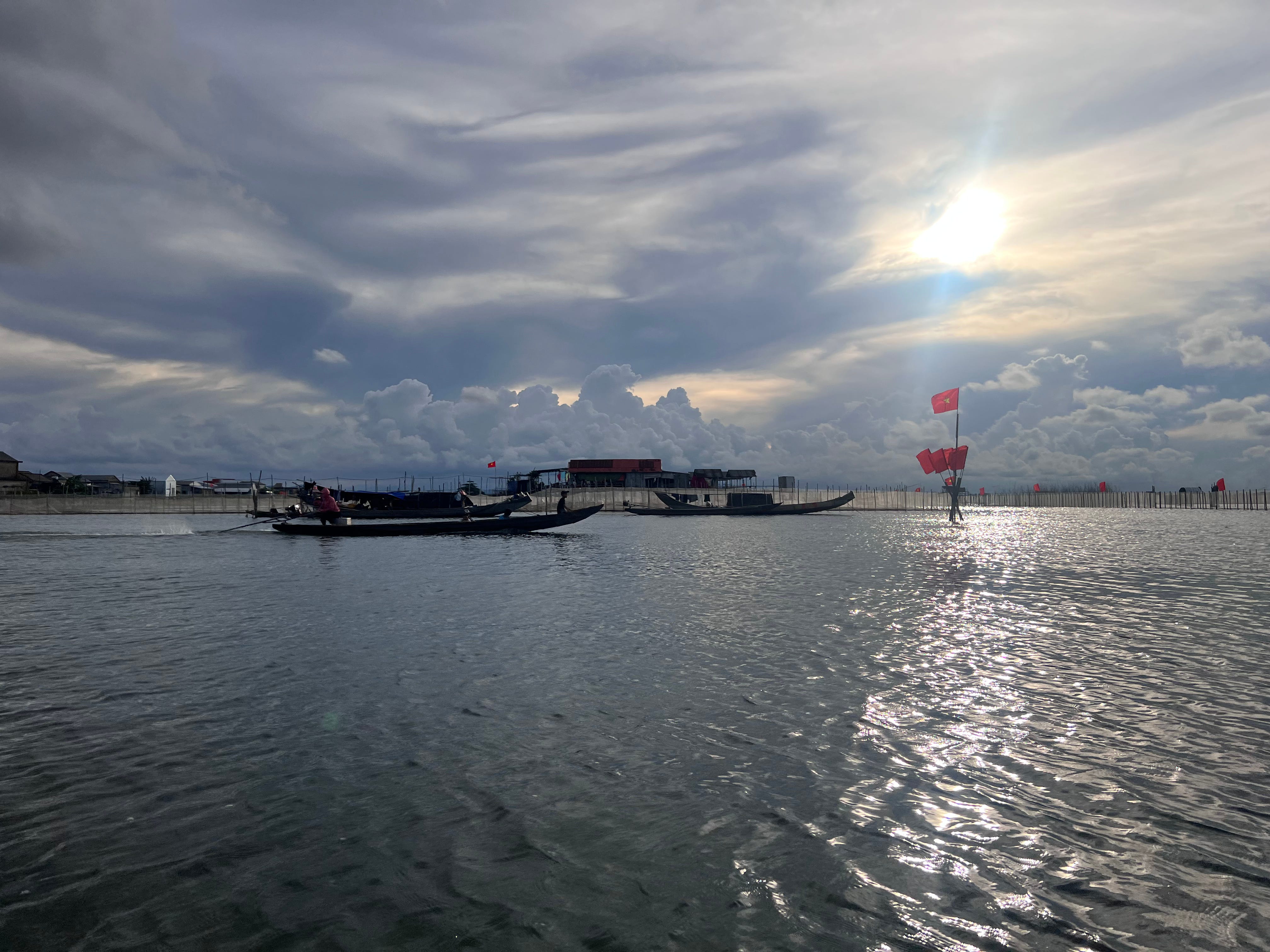
Nightfall on Huế’s Chuồn Lagoon
This week’s top picks
A memory practice: an artist kept a visual diary of fish in Việt Nam’s central coastal provinces which were found dead in the disaster while waiting for the government’s investigation results.
https://soi.today/?p=207434
A two-parter podcast on Jane Fonda
Từ hồi nghe vụ formosa trên thời sự mỗi lần nghe tên formosa em flinch =)) nhớ rõ vãi